Therapy in Guelph
These are trying times. Things feel heavy and it’s harder than ever to slow down and decompress at the end of the day. We are constantly consuming content these days so we can stay informed or maybe try to feel some semblance of control. As a result, one of the most common things I’m seeing right now in my practice is disruption in sleep, an increased feeling of being “on edge,” “unsettled,” or burnt out.
This makes sense, things feel unsafe, it’s hard to afford things, we’re constantly bombarded with news. So, how do we typically want to cope with this kind of stress? Doom scrolling, binge-watching and just generally avoiding the feelings. When we focus too hard we feel like we may get swept up in hopelessness, fear, anxiety, anger or depression.
But what are we actually doing? We’re prolonging the stress cycle, meaning we are going to feel on-edge, stressed and unable to sleep for longer. While we may want to problem-solve our way out of the stressor itself, that likely won’t fully resolve the physiological reactions we have when stressed, not to mention if we allow ourselves to work through the stress cycle we regain access to our internal resources such as insight and compassion allowing us to better problem solve (if that’s needed) and thus resolve the stressor. So, what is the stress cycle exactly?
The Stress Cycle
The stress cycle is what begins when a trigger/stressor whether real or perceived is processed as a threat by our brain. Stressors and triggers can be anything from being late for an appointment to debt or financial issues to witnessing horrible things in the news. No matter the stressor, if our brain perceives it as a threat, we’ll move into a response/reaction state.
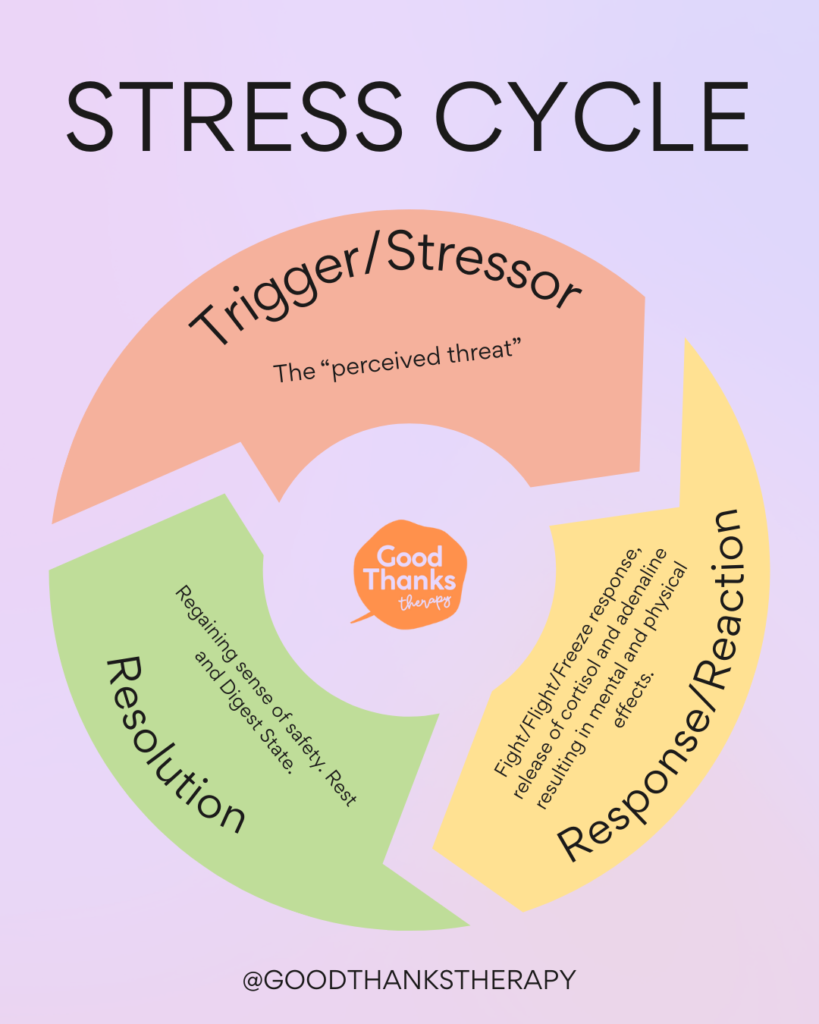
A response/reaction is that fight/flight/freeze response. It’s where cortisol and adrenaline are released to help us manage the threat in hopes of quickly getting back to safety. This ends up resulting in mental and physical effects such as muscle tension, headaches, increased heart rate, rumination, spiraling thoughts, anxiety attacks, sleep disturbances, anger, agitation, and more. For many of us, these mental and physical effects are clear signals that we’re stressed and we need to do something about it. However, in today’s world, that may not be quite that simple.
The stress cycle is often prolonged now, with the influx of information at our fingertips, we are constantly exposed to things that can be a trigger for a stress response. In fact, many of us live with chronic stress due to financial instability, marginalization, the constant need to scroll certain apps. This can mean that our default isn’t to try and complete the stress cycle; the feelings associated with stress are normalized by society and by ourselves the longer we live with it. However, that long-term stress can become too much, resulting in burnout or impacting areas of your life that may it impossible to ignore any longer – health, relationships, work, community.
Okay, I’m Stressed! What Do I Do About It?!
Lots of things! Once you’re aware of your stress, you have an abundance of things you can do to try to close the stress cycle.
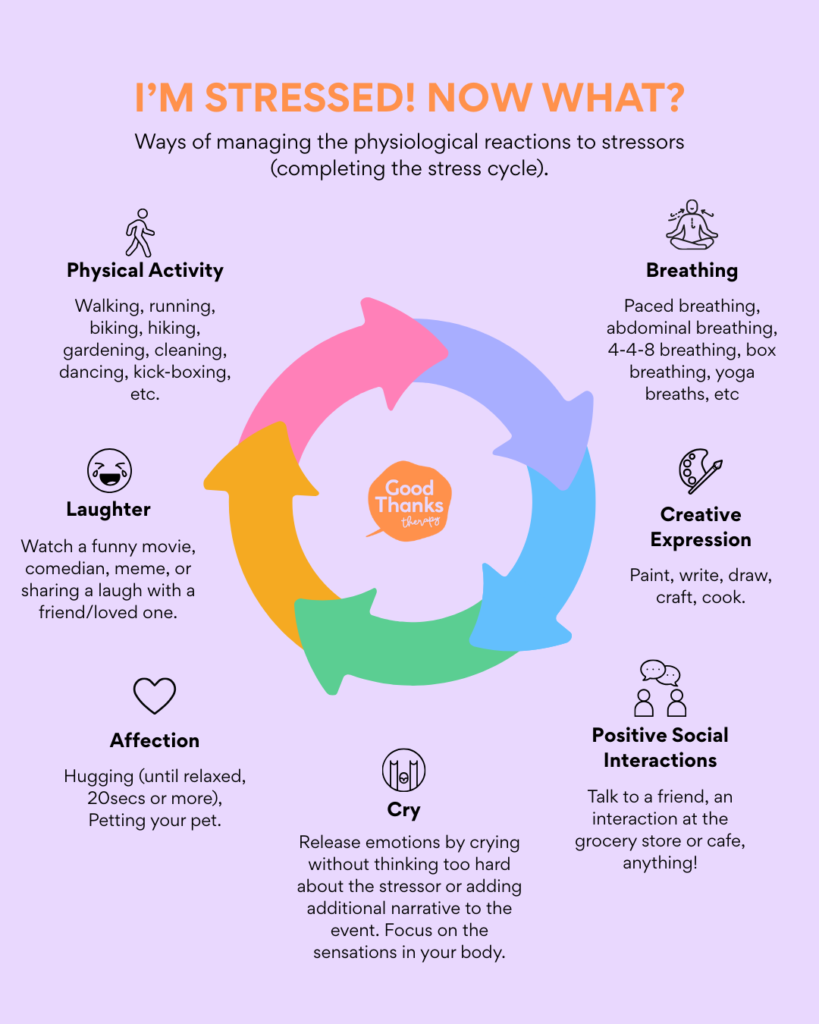
- Breathing – whatever breathing technique works for you! Paced breathing, yoga breaths, box breathing.
- Creative Expression – Get creative! Paint, draw, cook, craft, write!
- Positive Social Interactions – Talk to a loved one, talk to a cashier at the grocery store, anything!
- Cry – Try not too think too hard about the stressor or add a narrative to it. Focus on what’s happening in your body, notice the sensation of tears down running down your face.
- Affection – Hug someone until you feel more relaxed (20secs or more), cuddle with your pet.
- Laughter – Watch a funny movie, listen to a comedian, scroll through memes, laugh with a friend.
- Physical Activity – walk, run, bike, stretch, clean, garden! Anything that lets you release, physically, some of the stored energy associated with stress.
You may try one and feel better or it may take several things on this list to get to a place of feeling safe and less stressed.
Now, when we live with chronic stress, completing the stress cycle is not quite this simple. However, attempting to complete the stress cycle for smaller, more immediate stressors (like too much doomscrolling the news) can still be helpful. Long-term chronic stress, often involves more attention especially when you begin to notice impacts to your health, relationships, work or signs of burnout. In this case, while we can still work to improve our reaction to smaller stressors, our long-term stress may require support in working through it’s effects with a therapist.
I’m accepting new clients in Ontario and Newfoundland. I support clients working through major life transitions and stressors, burnout, chronic illness and more. Book a FREE 20-minute consult here.